The ability to stop and slow down is the most important part of providing you with a safe drive. But, how does your brake system work? Group 1 Ford of Pensacola decided to give drivers in the Pensacola, Crestview, and Fort Walton Beach areas a rundown of some of the parts that control your speed with this review of brake pads vs. rotors.
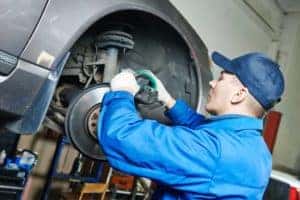 Brake pads are a thin metal block made of friction material that’s used to slow and stop your vehicle. They’re the parts that most directly work toward slowing you down.
When you press down on the brake pedal, the pressure you apply goes to the main cylinder. From there it pushes that pressure out toward the wheels using brake fluid. At the end of the brake lines there’s a clamp, called a caliper.
Brake pads are located on both sides of the calipers. That pressure is sent to them as they clamp down to create friction. This friction and the force that it’s applied with are how your car slows down and stops.
The pressure that the calipers clamp down with isn’t enough to slow you down alone. The material that brake pads are made with is designed to create the necessary friction. Usually they’re made of a mix of metal, ceramics, and organic materials.
Since brake pads are where pressure ends up and they’re designed to create friction, they will have to be replaced from time to time. Luckily, they’re specifically designed to wear down and let you know when you need new ones.
Brake rotors are a metallic disc that’s attached to the vehicle’s front and rear axles. If you’ve ever seen a silver circle peeking out through the spokes of a wheel, that’s a rotor. Their shape is where the term disc brakes comes from.
These rotors move with your wheels and match their speed. As they spin, they’re bordered by the calipers. They are what the caliper and brake pads clamp down on when you step on the brake pedal.
Unlike the brake pads, rotors are made of smooth steel to help them spin aerodynamically. Plus, the difference between their materials helps create friction in a way that won’t damage either part.
There’s a couple different types of brake rotors. Solid rotors are common on smaller cars and look like one solid metal disc. Ventilated rotors have the same shape but feature a series of small holes on them. This is to keep them from overheating. They’re more common on larger vehicles like trucks.
While they’re designed to hold up for a long time, applying pressure and friction to a rapidly spinning metal disc can take its toll. That’s why service technicians always give your brake rotors a visual inspection.
 Part of that inspection involves checking for cracks in the rotors. If you ever run into this problem, you’ll probably hear a grinding sound when you press the brake pedal.
A more routine brake procedure is replacing your brake pads. Our technicians will check how thin they are when you come in.
One way you’ll know it’s time to replace them is if you hear the classic squeaking brakes. This unmistakable sound is actually by design. Since your brake pads wear down there’s a tiny screw inside them that will cause your brakes to make this sound.
When you hear this sound, go ahead and schedule service with our team. We pride ourselves on helping drivers in the Pensacola, Crestview, and Fort Walton Beach areas stop safely.
For more information on brake pads vs. rotors, and the rest of your brake system, visit us at Group 1 Ford of Pensacola.